

Tyre Recycling: Is the UK Treading Too Carefully?

Every year, millions of tyres reach the end of their life in the UK and, on the surface, the system appears to function effectively. Collection rates are high, landfill has been eliminated, and the infrastructure in place suggests a mature approach to waste management.
However, a closer look reveals a different reality. The UK is not failing to process tyres—it is failing to capture their value.
End-of-life tyres are not simply a waste stream to be disposed of or burned for energy. They are a source of recoverable materials—rubber, carbon, and hydrocarbons—that can play a significant role in a circular automotive economy. While parts of Europe are increasingly treating tyres as a resource, the UK continues to rely on lower-value outcomes, including export and energy recovery.
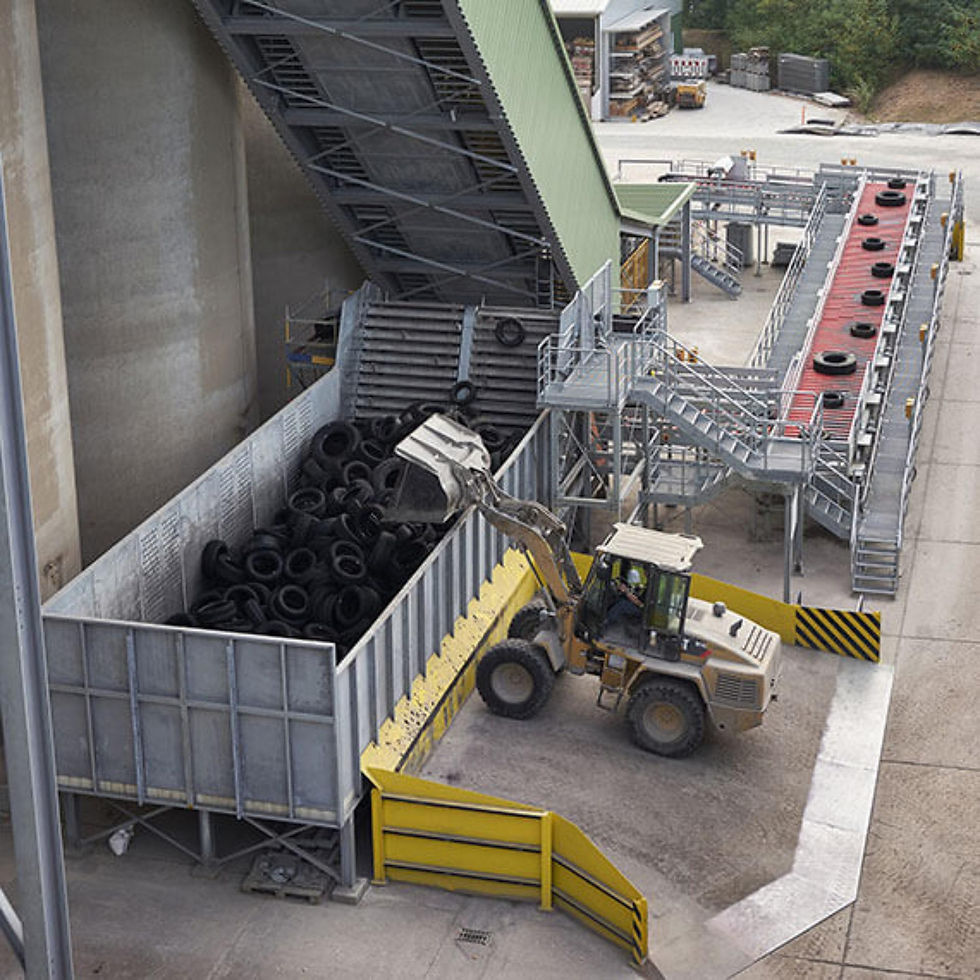
For many years, export has provided a convenient solution. It has allowed the system to operate without the need for significant domestic investment in processing or end markets.
Since the landfill ban introduced in 2002, the UK has achieved collection rates of around 94% of its ~50 million tyres annually, placing it among the strongest performers globally.
But as export routes become more constrained and less predictable, this approach is being tested. The reliance on export has masked a structural weakness: the UK has not developed the infrastructure or downstream demand required to fully utilise its own material. As a result, value continues to leave the country, and the UK remains behind leading European markets in terms of circular capability.
Policy and System Maturity
The UK’s regulatory framework has been effective in diverting tyres from landfill, but it has not delivered a fully circular system.
In several European markets, the focus has shifted towards material recovery. Tyres are increasingly processed into secondary raw materials—such as recovered carbon black and reusable rubber—which are fed back into manufacturing supply chains. Companies such as Pyrum Innovations, Scandinavian Enviro Systems, and collaborations involving Nokian Tyres demonstrate how this model is developing at scale.
By contrast, a significant proportion of UK tyres—particularly those exported—are ultimately used for energy recovery. While this is classified as recovery, it represents a terminal use and does not contribute to circularity.
Current Processing Reality
The UK’s tyre flows broadly reflect those of other advanced economies, but with a higher reliance on export.
Around 50% is processed domestically into beneficial reuse:
~15% retreading
~25% mechanical recycling (crumb rubber)
Around 15% is used as tyre-derived fuel
Around 35% is exported for processing overseas
That export figure is the critical gap.
By comparison, the EU directs a greater share of tyres into material recovery, while markets such as the US and India are advancing alternative processing routes, including large-scale chemical recycling.

Materials and the Opportunity
The distinction between current practice and future potential lies in how tyres are ultimately used.
When used as fuel, tyres provide a one-time energy output, after which their material value is lost. In contrast, when processed into secondary materials, they can support ongoing industrial use.
Mechanical recycling produces crumb rubber for construction and sports applications. More advanced processes recover carbon black for use in tyres, plastics, and coatings. Devulcanisation enables rubber to be reused in new products, while chemical recycling generates oil for petrochemical and fuel applications.
These pathways demonstrate that tyres are not waste, but a reusable material resource capable of supporting multiple value cycles.
What Needs to Happen Next
If the UK is to move beyond managing tyre waste and begin capturing its full value, the focus must shift from volume to value. The challenge is not technology—it is system alignment.
Domestic processing capacity needs to expand, particularly in higher-value outputs such as recovered carbon black, devulcanised rubber, and chemical feedstocks. Without this capability, tyres will continue to be treated as a low-value commodity rather than a source of industrial raw materials.

At the same time, end markets must develop. Recycling alone does not create circularity—demand does. Stronger links between recyclers, manufacturers, and the wider automotive and chemical sectors will be essential if recycled materials are to be used at scale.
Reducing reliance on export is also critical. Export should remain a balancing mechanism, but not the default solution. Retaining material within the UK is fundamental to capturing value and building resilience.
Finally, emerging technologies such as chemical recycling must move beyond pilot stage into commercially viable infrastructure capable of operating at scale.
The Role of Government
The issue is not whether government should fund the sector directly, but whether it should shape the conditions in which it operates.
At present, export and energy recovery remain the most commercially attractive options. Without policy signals to support higher-value material recovery—through standards, incentives, or improved traceability—the market will continue to favour lower-value outcomes.
Targeted intervention, rather than heavy regulation, has the potential to accelerate progress significantly.
A Question of Material Security
This is no longer just a waste issue—it is an issue of material security.
End-of-life tyres contain carbon, hydrocarbons, and reusable materials that could support domestic manufacturing. By exporting them, the UK is effectively exporting future raw materials, only to re-import value further down the supply chain.

Conclusion
The UK has built an effective system for collecting tyres. The next step is to build one that captures their value.
This will require better alignment between industry, investment, and policy. Without it, the UK will continue to collect efficiently—while exporting opportunity.
The question is not whether the UK can continue to export tyres. It is whether it can afford to keep exporting their value.


Comments