

Are today's commercial pressures quietly changing the safety profile of UK recycling sites?

The UK recycling industry is operating in one of the most challenging markets it has faced in years.
Commodity prices remain volatile, operating costs continue to rise, export markets are becoming increasingly uncertain, and environmental compliance has never been more demanding.
Faced with these pressures, operators are making rational commercial decisions. Material is often held on site for longer while waiting for markets to improve, while every square metre of available space is expected to work harder than ever before.
None of this is surprising.
It is exactly how resilient businesses adapt.
But markets don't just change prices.
They change risk.
This article is not about whether operators are complying with their permits. It is about whether changing commercial realities are gradually changing the assumptions on which those permits, Fire Prevention Plans and emergency arrangements were originally based.
Commercial Reality Is Changing Site Operations
Holding material for longer naturally results in larger stockpiles.
At the same time, many recycling facilities are under increasing pressure to maximise the productivity of their existing footprint. Land is expensive, planning restrictions often limit expansion, and operators have little choice but to make the most of the space they already have.
The result is almost inevitable.
Stockpiles become larger.
Stockpiles become higher.
Stock remains on site for longer.
The space between stockpiles becomes smaller.
None of these decisions are unreasonable.
In many cases, they are commercially necessary.
But collectively they may be changing the way our sites function during both normal operations and emergency situations.

Fire Is Only One Part of the Conversation
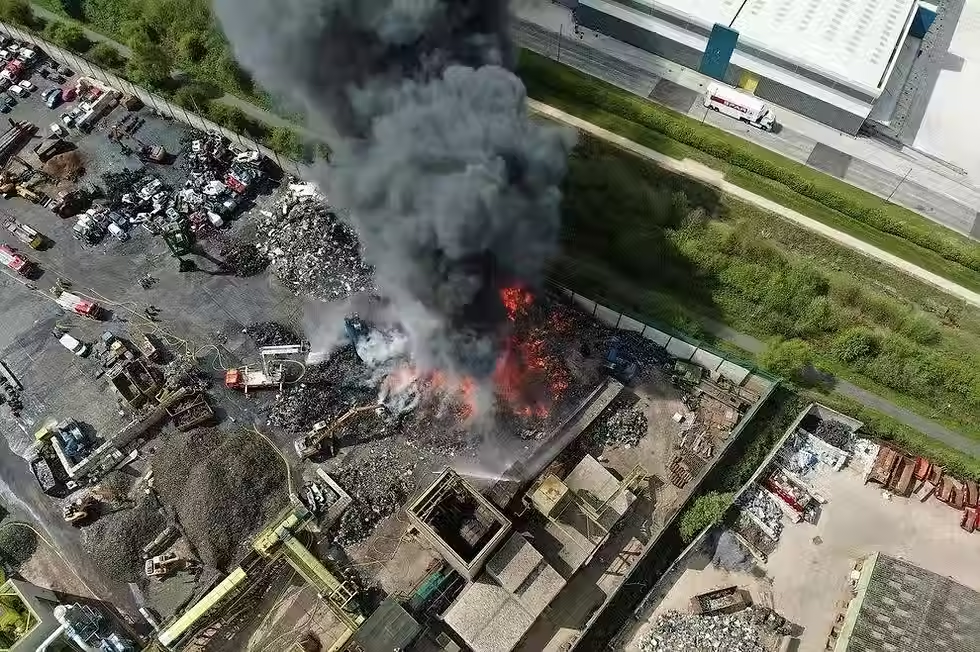
Recent fires at scrap and recycling facilities have understandably focused attention on the risks associated with storing large volumes of combustible material.
However, fire is only one consequence of larger, denser stockpiles.
As storage areas become more congested, the separation distances that once provided fire breaks, emergency access and operational flexibility can gradually disappear.
Those spaces are not wasted land.
They are part of a site's safety infrastructure.
They allow fire appliances to reach an incident quickly, provide firefighters with room to deploy equipment, enable mobile plant to separate burning material, and help prevent fire spreading from one stockpile to another.
If those spaces are gradually lost in the pursuit of greater storage efficiency, we should ask a simple question:
Can we still manage an emergency as effectively as we once could?
Engineering Risks Deserve Equal Attention
Fire is not the only issue.
As stockpiles become larger and higher, so too do the forces they exert.
Across parts of the industry, it is becoming increasingly common to see large quantities of scrap stored directly against perimeter fences, concrete walls, shipping containers and other structures.
Yet many of these structures were never designed to retain thousands of tonnes of material or withstand the lateral forces generated as stockpiles settle, shift and are repeatedly loaded and unloaded.
If those structures fail, the consequences may extend well beyond the site boundary.
This becomes particularly important where public footpaths, highways, neighbouring businesses or environmentally sensitive areas exist immediately beyond the perimeter.
The question is not whether operators are deliberately creating risk.
Most are responding to genuine commercial pressures that affect the entire sector.
The question is whether our engineering assumptions have kept pace with changing operational realities.

Compliance Is Not Static
One of the realities of environmental regulation is that it is largely front-loaded.
When a permit is granted, operators are told what standards they must achieve and are expected to design their site, management systems and Fire Prevention Plan accordingly.
But recycling businesses are not static.
Markets change.
Throughput changes.
Stock levels fluctuate.
Commercial pressures evolve.
A site that operated comfortably within its design limits five years ago may look very different today.
Regulators cannot be present every day to assess those changing conditions, nor should they need to be.
The responsibility ultimately rests with the operator to continually ask a fundamental question:
Can this site, operating as it is today, still deliver everything our Fire Prevention Plan, emergency procedures and environmental management systems say it can?
If stockpiles are larger, materials remain on site for longer, access routes have become narrower or storage areas denser, then those changes should trigger more than a commercial discussion. They should prompt a fresh assessment of whether emergency access, fire separation distances, stockpile stability, structural loading and operational resilience remain adequate.
Compliance should never be viewed as something achieved on the day a permit was issued.
It should be continually demonstrated as a site evolves.

A Conversation Worth Having
The recycling industry is fundamental to the UK's circular economy, and commercial pressures will always influence how businesses operate.
Operators will quite rightly continue to maximise the efficiency of their sites.
But every commercial decision has a safety consequence.
Holding material for longer.
Building larger stockpiles.
Stacking material higher.
Reducing separation distances.
Maximising every square metre of available space.
None of these decisions are unreasonable in isolation.
In many cases, they are commercially necessary.
But together they may be quietly reshaping the risks that operators, regulators and emergency responders are expected to manage.
Perhaps the most important question we can ask is this:
Can this site, operating exactly as it is today, still deliver everything our Fire Prevention Plan, emergency procedures and environmental management systems say it can?
Because compliance isn't something that was achieved on the day a permit was issued.
It's something that has to be demonstrated every single day the site operates.


Comments