

A Reminder That Scrapyard Fire Risk Doesn't End After One Incident

When a fire occurs at a recycling facility, the immediate focus is rightly on protecting lives, containing the incident and supporting the Fire and Rescue Service. Once the flames are extinguished and operations resume, it is easy to view the event as an isolated incident.
However, perhaps we should be asking a different question.
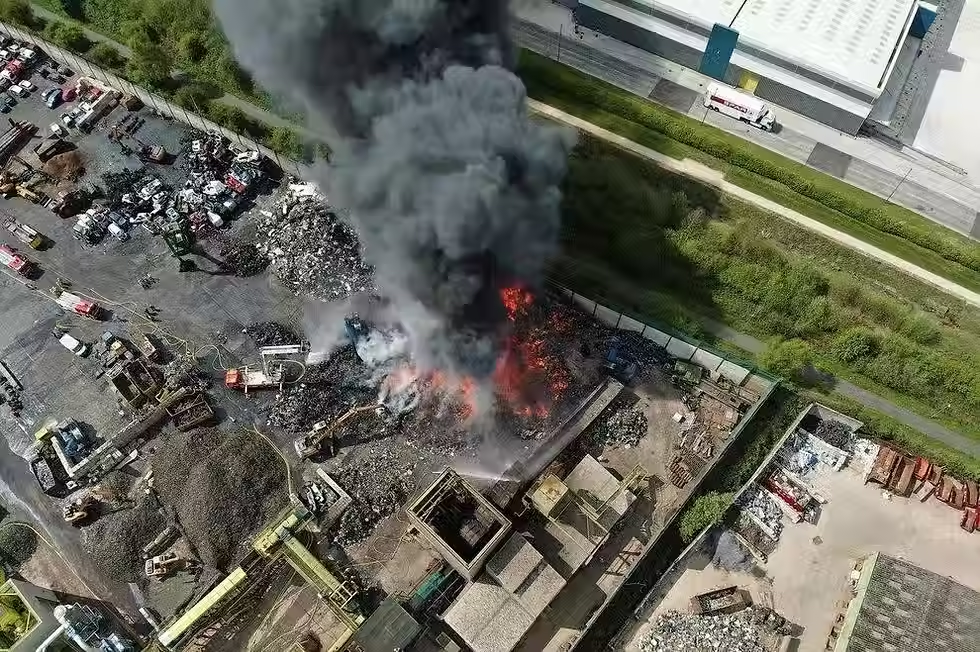
The scrapyard fire at the Global Ardour Recycling site in Preston this weekend is reported to be the second significant fire at the site this year. Publicly reported incidents also show that the site has experienced a number of major fires over the past decade under both its current ownership as Global Ardour Recycling and its previous ownership as Recycling Lives.
At first glance, it would be easy to conclude that more should have been done. Yet recent reports have highlighted the significant investment Global Ardour has made in developing the site, improving operational standards and working closely with Lancashire Fire and Rescue Service to strengthen its emergency preparedness.
Perhaps that tells us something important.
Perhaps the lesson isn't that fire prevention has failed. Perhaps the lesson is that the recycling industry has entered a new era where fire is a risk that can rarely be eliminated entirely—it can only be managed.
The challenge for today's recycling operators is not simply preventing fires, but building resilient businesses that are prepared to respond effectively when incidents occur.
Every Fire Is an Opportunity to Learn
Major fires at recycling facilities have become an unfortunate reality. The waste and metal recycling sectors handle vast quantities of combustible materials, increasingly complex waste streams and growing numbers of products containing lithium-ion batteries.
Whether a fire begins through equipment failure, hot works, self-heating, arson, damaged batteries or another cause, the consequences can be significant.
Rather than simply watching another fire unfold on the evening news, every recycling operator should pause and ask:
Could this happen on our site?
Would our emergency procedures actually work in practice?
Have we reviewed our Fire Prevention Plan recently?
Are our employees confident in what they should—and shouldn't—do?
Have we learned everything we can from previous incidents across the industry?
These questions should be asked before the next emergency, not afterwards.

From Fire Prevention to Fire Resilience
Fire prevention remains the objective. But prevention alone is no longer enough.
Today's recycling facilities process materials that simply did not exist in significant quantities twenty years ago. Lithium-ion batteries are now hidden within electric vehicles, hybrid vehicles, power tools, e-bikes, e-scooters, consumer electronics, household appliances and disposable vapes. Many arrive damaged, degraded or unidentified.
Although there is no evidence that lithium-ion batteries were involved in the recent Preston fire, they represent one of the fastest-growing fire risks facing the recycling industry.
This means Fire Prevention Plans (FPPs) must become living documents that continually evolve as risks change.
Operators should regularly review whether their plans adequately address emerging hazards, reflect current site operations and remain practical in the event of a real emergency.
Preparedness Is More Than Having a Procedure
Having an emergency plan is one thing.
Knowing that it works is something entirely different.
Emergency response procedures should be practised regularly through realistic exercises that test:
Alarm activation and response times.
Staff evacuation procedures.
Communication with emergency services.
Site access for the Fire and Rescue Service.
Roles and responsibilities during an incident.
Environmental protection measures.
Business continuity arrangements.
Every exercise should conclude with a structured debrief.
What worked?
What didn't?
Where were the delays?
How could communication be improved?
Every exercise should make the next response better than the last.
Good Housekeeping Can Prevent a Small Fire Becoming a Major Incident

No operator can completely eliminate fire risk.
However, every operator can influence how serious the consequences become.
Good housekeeping remains one of the most effective fire prevention measures available. Combustible materials should not be allowed to accumulate unnecessarily, ignition sources should be controlled and routine inspections should identify hazards before they develop into incidents.
Equally important is managing the site's overall fire load.
Large stockpiles provide fuel that allows fires to spread more rapidly, burn for longer and generate greater quantities of smoke and contaminated firefighting water.
Keeping stockpiles to sensible sizes and maintaining suitable separation distances can significantly reduce the scale of an incident.
Waste segregation is equally critical.
Incompatible waste streams should be separated wherever practicable, particularly materials containing lithium-ion batteries, tyres, plastics and other combustible products. Effective segregation not only limits fire spread but also gives firefighters greater opportunities to contain an incident safely.
Emergency planning should also consider how plant and machinery could be deployed, where it is safe to do so, to create fire breaks or remove unaffected stock, reducing the available fire load before the incident escalates.
Just as importantly, operators should think beyond the fire itself.
How will contaminated firefighting water be contained?
How will neighbouring businesses and local communities be protected?
How can smoke, pollution and environmental damage be minimised?
These questions should form part of every emergency exercise.
Sometimes the Safest Response Is to Step Away
One of the biggest misconceptions surrounding lithium-ion battery fires is that they can be tackled in the same way as conventional fires.
In reality, once thermal runaway occurs, extinguishment can be extremely difficult.
There may come a point where continuing to fight the fire exposes employees to unacceptable risk.
Training should give staff the confidence to recognise when evacuation is the safest course of action, allowing the Fire and Rescue Service to take control.
Protecting life must always take priority over protecting property.
Success Is Measured by More Than Preventing Fires
Perhaps one of the biggest lessons from the Preston incidents is that success should no longer be measured solely by whether a fire occurs.
The better measure is how effectively a business prepares for that possibility:
How quickly was the alarm raised?
Were staff evacuated safely?
Did emergency procedures work?
Were firefighters able to access the site quickly?
Were stockpiles managed to limit fire spread?
Was pollution minimised?
Were lessons identified and shared afterwards?
These are the questions that define resilience.
Emergency Preparedness Is an Investment, Not a Cost
No recycling business expects to experience a major fire. Yet every operator has a responsibility to prepare for one.
Emergency preparedness should be viewed as a continuous process of reviewing risks, testing procedures, improving site management and learning from incidents—both on your own site and across the wider industry.
Every fire should leave behind more than damage.
It should leave behind knowledge.
Because the question every recycling operator should now be asking is no longer simply:
"How do we prevent a fire?"
It is:
"If a fire starts on our site tomorrow, how effectively will our people, our procedures and our site respond?"
In today's recycling industry, resilience may prove just as important as prevention.


Comments