

The Race to Close the Loop: Which Automotive Manufacturers Are Leading Glass Recycling?

When people talk about the automotive circular economy, the conversation usually centres around batteries, aluminium and plastics. Yet one of the most overlooked — and increasingly important — materials is automotive glass.
Modern vehicles contain increasingly complex glazing systems:
laminated windscreens
panoramic roofs
HUD-compatible glass
solar coatings
embedded sensors and antennas
acoustic glazing
Historically, most of this material was crushed during shredding and downcycled into low-value aggregate or insulation feedstock. That is now changing rapidly. The automotive industry is beginning to move toward something far more ambitious: old vehicle glass becoming new vehicle glass. And a handful of manufacturers and suppliers are now positioning themselves at the forefront of this transition.
Why automotive glass has become strategically important
Glass manufacturing is extremely energy intensive.
By increasing recycled glass content — known as cullet — manufacturers can:
significantly reduce furnace temperatures
cut CO₂ emissions
reduce virgin raw material consumption
lower dependence on silica sand extraction
The environmental gains are substantial.
According to recent industry figures:
every tonne of recycled cullet can save up to 0.7 tonnes of CO₂
every tonne of cullet can replace approximately 1.2 tonnes of virgin raw materials
For OEMs under increasing pressure to reduce lifecycle emissions, automotive glass is becoming a serious circularity opportunity.
AGC Glass Europe — arguably the current industry leader
At present, AGC appears to be one of the most advanced players pushing true closed-loop automotive glass recycling. In May 2026, AGC announced a major breakthrough alongside German recycler Reiling Glas Recycling:
assembled automotive windscreens are now being recycled back into new automotive glass on an industrial scale
the process successfully separates:
PVB interlayers
coatings
wiring
electronic contaminants
AGC says its Retenice automotive furnace is now operating with an average 56% cullet ratio
This is significant because laminated windscreens have historically been one of the hardest automotive materials to recycle at high value.
The partnership demonstrates that “flat-to-flat” recycling is now commercially viable:
old windscreen → new windscreen.
That represents a major step toward genuine circular manufacturing.
Key partners involved
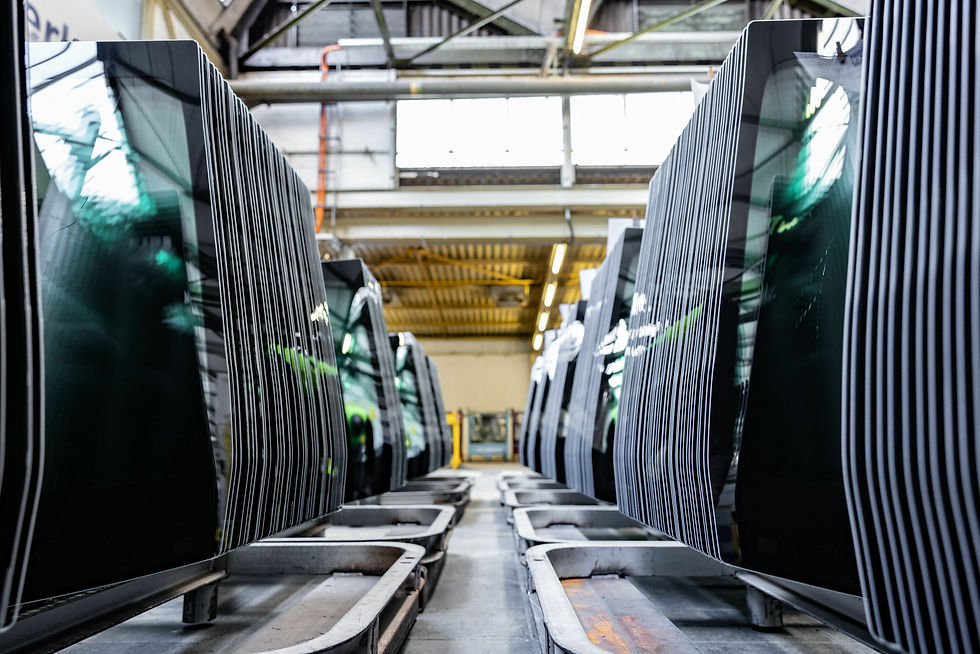
Saint-Gobain Sekurit — scaling collection networks across Europe
Saint-Gobain Sekurit is taking a slightly different approach, focusing heavily on collection infrastructure and recycled-content glazing.
The company has been expanding European collection systems for end-of-life and replacement windscreens through its Sekurit AGR operations.
Its strategy centres around:
collecting used windscreens from repair centres
separating laminated materials
recovering glass and polymers
feeding materials back into industrial manufacturing streams
In 2024 alone, Sekurit reported collecting and recycling more than 100,000 windscreens across Europe.
More recently, Saint-Gobain Sekurit introduced:
“SEKURIT OTAE®”
a lower-carbon automotive glazing product containing at least 60% external recycled cullet
with claimed CO₂ reductions of 20–30% versus conventional glazing
Why this matters
Saint-Gobain’s strength is scale.
Unlike smaller recyclers, it already controls:
glazing production
replacement networks
recycling streams
insulation manufacturing
That allows it to create vertically integrated circular systems.
Key organisations involved

NSG Group / Pilkington — focusing on large-scale glass circularity
The owner of Pilkington has also been investing heavily in flat-glass recycling through its “renew:glass” initiative.
The company has highlighted a major industry challenge - less than 1% of global float glass waste is currently recycled back into float glass production.
Pilkington’s approach appears focused on:
scaling cullet collection
improving furnace efficiency
increasing recycled-content float glass
expanding closed-loop recycling partnerships
While much of the public messaging currently focuses on architectural glass, the technologies and infrastructure directly overlap with automotive glazing production.
Key initiative
What about vehicle manufacturers themselves?
Interestingly, many of the most advanced developments are currently being driven not by OEMs directly, but by:
glazing manufacturers
materials companies
recycling specialists
However, OEM pressure is accelerating everything.
Manufacturers such as Toyota, Volvo Cars, BMW Group and the Mercedes-Benz Group,
are all aggressively pursuing:
lifecycle carbon reduction
recycled-content sourcing
circular manufacturing strategies
digital material traceability
That pressure flows directly down into suppliers like AGC and Saint-Gobain.
Why Toyota’s Circular Factory concept could become highly relevant
Toyota’s emerging circular factory strategy is particularly interesting in this space.
A future advanced ATF or circular processing facility could potentially:
remove glazing before shredding
digitally classify glass types
separate laminated and tempered glass
recover clean cullet streams
support closed-loop OEM glazing production
That would represent a major evolution away from traditional shredder-based ELV processing.
The key shift being that Glass, for Car Makers, is no longer being viewed as waste, it is becoming a recoverable manufacturing feedstock.
The next frontier: post-consumer ELV windscreens
Most current breakthroughs involve:
pre-consumer waste
factory offcuts
replacement windscreens
The really difficult challenge still ahead is:
large-scale recovery from end-of-life vehicles.
This requires:
intact glass removal
advanced dismantling
contamination reduction
robotic separation systems
highly disciplined ELV pre-processing
But this is exactly where the industry appears to be heading.
The companies to watch
Automotive glazing manufacturers

Recycling and processing specialists
Circular economy organisations
Final thoughts
The automotive industry is entering a new phase of circularity.
For decades, vehicle glass was one of the hardest materials to recover at high value.
Now, for the first time, industrial-scale closed-loop automotive glazing is becoming technically and commercially realistic.
The companies leading this shift are not simply recycling waste, they are redesigning the entire material lifecycle of automotive glass.
And as OEMs push toward whole-vehicle carbon accounting, recovered windscreens may soon become as strategically important as recycled aluminium, plastics and even battery materials.


Comments