

When Did Metal Recyclers Site Boundaries Become Retaining Walls?
- Mark Jones
- Jun 18
- 2 min read

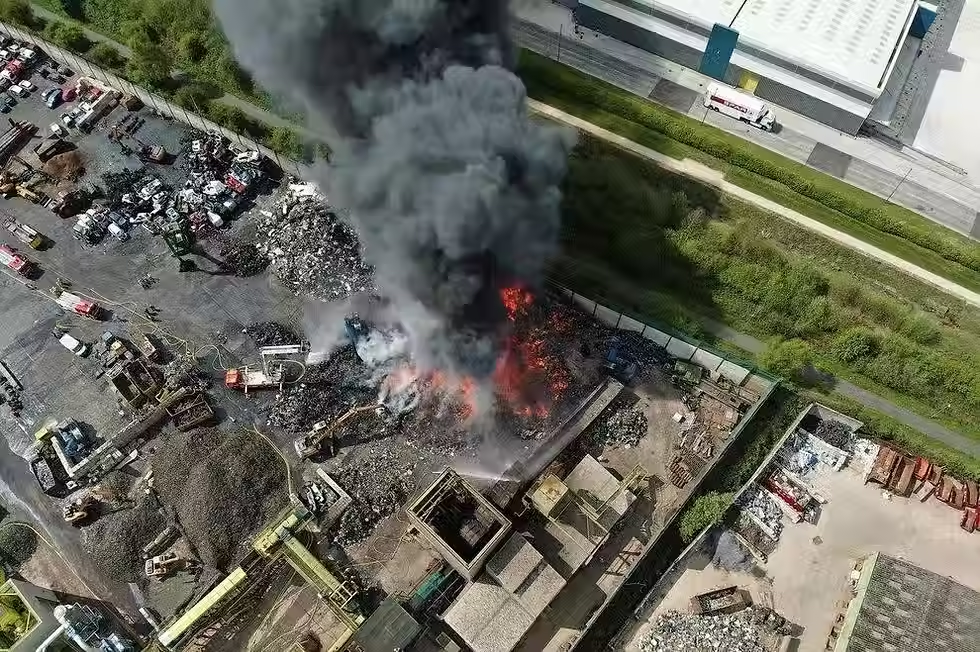
Recent fires at scrap and recycling facilities have highlighted the risks associated with large stock
piles of combustible materials. But fire is only one of the questions we should be asking.
Looking at some recycling facilities around the UK, a different concern becomes apparent. Why are we comfortable allowing large metal stockpiles to be stored directly against perimeter fences, walls, shipping containers, and other structures that may never have been intended to retain the weight of thousands of tonnes of material?
As an industry, we spend considerable time discussing fire prevention, pollution control, and environmental compliance. Yet far less attention seems to be given to the engineering risks associated with stockpile management.

Metal stockpiles exert significant forces on anything used to contain them. If material shifts, settles, or is loaded incorrectly, those forces can increase dramatically. The consequences of a boundary failure could extend well beyond the site itself.
This becomes even more concerning when site boundaries adjoin public areas.
In this case, a public coastal path and green space sit immediately behind the site boundary. If a stockpile were to collapse, if containment structures failed, or if a fire spread beyond the perimeter, the consequences would not be confined to the operator's land. Members of the public, neighbouring businesses, and emergency responders could all be placed at risk.
The question is not whether a site is compliant with its permit. The question is whether compliance alone is enough.

Should operators be required to maintain clear stand-off distances between stockpiles and site boundaries?
Should perimeter fences, walls, and shipping containers be prohibited from acting as stockpile retaining structures unless they have been specifically engineered and certified for that purpose?
Should regulators place greater emphasis on stockpile stability and boundary protection where public access exists immediately beyond the site perimeter?
The recycling industry is essential to the circular economy, but public confidence depends on more than compliance. It depends on demonstrating that risks have been identified, challenged, and reduced as far as reasonably practicable.
Perhaps it is time to ask a simple question:
When did site boundaries become retaining walls?


Comments